

Keep Your Head in the Clouds
BY PATRICIA WILSON
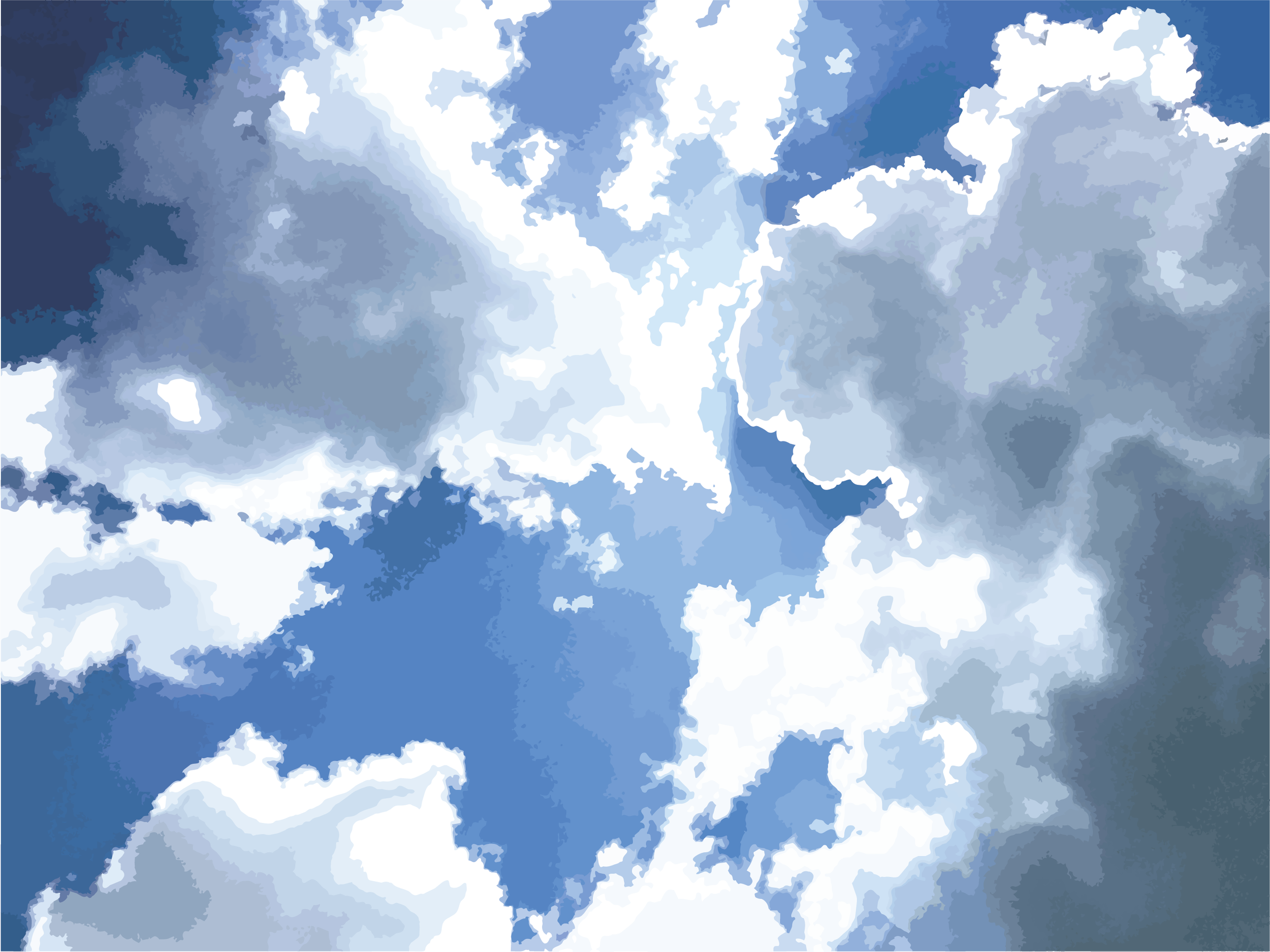
Have you ever looked up and seen fluffy white dragons or hippos floating across the sky? Or gazed at a sunset that resembles a fingerpainted stretch of bright orange and pink? Clouds are wondrous, remarkable things, and we’d have a hard time living without them.
That’s because clouds regulate the Earth’s temperature and provide us with rain. They balance our radiation budget. Low clouds reflect excess solar heat while others hold in heat. In fact, the total balance keeps the Earth cooler than if we hadno clouds. But what exactly are clouds, and what keeps them from floating away into space?
Clouds form as moist air rises and condenses around tiny dust, smoke, or chemical particles in the atmosphere. Lower clouds generally contain water vapor, while higher clouds are icy. These droplets of water vapor or ice stay up because they are almost microscopic and are constantly buoyed by updrafting warmer air.
But as these droplets grow heavier from repeated condensation, they do their job of transporting moisture across the globe. Clouds don’t float out into space because gravity pulls the heavier particles down as rain, snow, sleet, or hail. This precipitation gives life to our planet, and much more. As rain or snow falls, it gives rise to our rivers and streams and nurtures plant ecosystems. This precipitation also gradually wears away natural elevations such as mountains, and over time, forms our geological landscape.
ON CLOUD NINE
Clouds come in many shapes and sizes, mostly based on their altitude. Meteorologists can predict weather patterns based on their height and formation.
Cumulus clouds are the low, puffy, friendly looking clouds that drift by on a summer day. But when they rise high into the sky and become massively laden with heavy water droplets, they become cumulonimbus clouds that bring powerful thunderstorms and lighting. The heavy updrafts within the clouds create favorable conditions for static electricity to build up, forming lighting. Stratus clouds form a low, thick, gray blanket that often brings drizzle but can also insulate cold night air and keep your plants from freezing. The highest of all clouds are called cirrus. These wispy, dainty clouds develop at 20,000 feet or higher and are formed of ice crystals. There are also complex combinations of all these clouds.
If you’re flying in an airplane, look out the window and note that just about every cloud is below you. The part of the atmosphere where clouds form is called the troposphere. It has the correct temperature and moisture range plus continuous convection that allows clouds to form. This layer is 11 miles thick at the equator and only five miles thick at the poles.
Planes, however, typically fly into the stratosphere. This layer holds around 19 percent of our planet’s gases, but almost no water vapor, and acts as a cap to stop cloud formation. The stratosphere is windy, dry, and extremely cold (about minus 60 degrees).
So next time you see fantastical shapes in the sky, think about the many ways clouds spark our imaginations and the critical part they play in the Earth’s climate system.
To learn more about the science of clouds, visit NOAA.gov/jetstream/clouds. And, there is even a community organization for people who love the sky: the Cloud Appreciation Society, which posts stunning photos of clouds. Check it out at CloudAppreciationSociety.org.
Patricia Wilson moved to Orlando in 1990 and since then has been involved in understanding the science of Florida’s unique environmental issues. She has volunteered with NOAA’s Marine Microplastics Program and has worked with the American Association of University Women to develop a free educational program about how simple choices that we make can help improve water quality.